

Your Employer Withholds 22% on RSUs. For WA Tech Workers, That’s Only Half the Story.
It’s April. You open TurboTax and see an unexpected balance due. Your RSUs vested last year, your employer handled the taxes right there on the pay stub, and somehow you still owe the IRS more money than you were expecting. What happened?
The 22% flat withholding rate happened. It’s a standard IRS shortcut that works fine for median earners. It doesn’t work for a software engineer at Amazon or Microsoft making $200,000 or more with RSUs on top of it.
Here’s what this article covers: why the gap exists, what it looks like in real dollars, what’s unique about Washington state (one thing genuinely works in your favor, and one thing is shifting fast), and what you can actually do before next April surprises you again.
What “Supplemental Wage Withholding” Actually Means
The IRS lets employers use a flat 22% withholding rate on what they call “supplemental wages.” That category includes RSUs, bonuses, and commissions. It’s a shortcut, a way for employers to handle taxes on non-salary income without running a full bracket calculation for every employee.
The rate was set with the average earner in mind. For a lot of people, it works out close enough. For a senior tech employee in the Kirkland-Bellevue corridor earning well above $200,000, it doesn’t.
Here’s the thing: your employer isn’t doing anything wrong. They’re following the IRS rules exactly as written. The rules just don’t know your actual tax bracket. That’s your problem to manage.
One more nuance worth knowing: once supplemental wages exceed $1 million in a single year, the withholding rate jumps to 37%. But most employees aren’t there. The issue is the gap between 22% and the 32-35% bracket most high-earning tech workers actually land in.
If you’re unclear on how RSUs and ESPPs are taxed differently, this breakdown of the key tax rules covers both.
The Math That Surprises People Every April
Let’s put some numbers to it. These are simplified examples, your actual numbers will vary based on deductions, filing status, and other income, but they show how the gap adds up quickly.
Example 1: Single Filer, One Vest Event
A software engineer in Redmond earns $185,000 in base salary and has $100,000 in RSUs vesting in 2026. Total income: $285,000.
After the standard deduction of $16,100 for single filers in 2026, taxable income is roughly $268,900. Most of that income sits in the 32% bracket. Only the slice above $256,225 — about $12,675 — crosses into the 35% bracket. The RSU income effectively straddles both, producing a blended marginal rate around 32-33% on that income.
| Amount | |
|---|---|
| RSU vest value | $100,000 |
| Withheld by employer (22%) | $22,000 |
| Federal tax actually owed on RSU income (~32-33% blended) | ~$32,500 |
| Gap owed at filing | ~$10,500 |
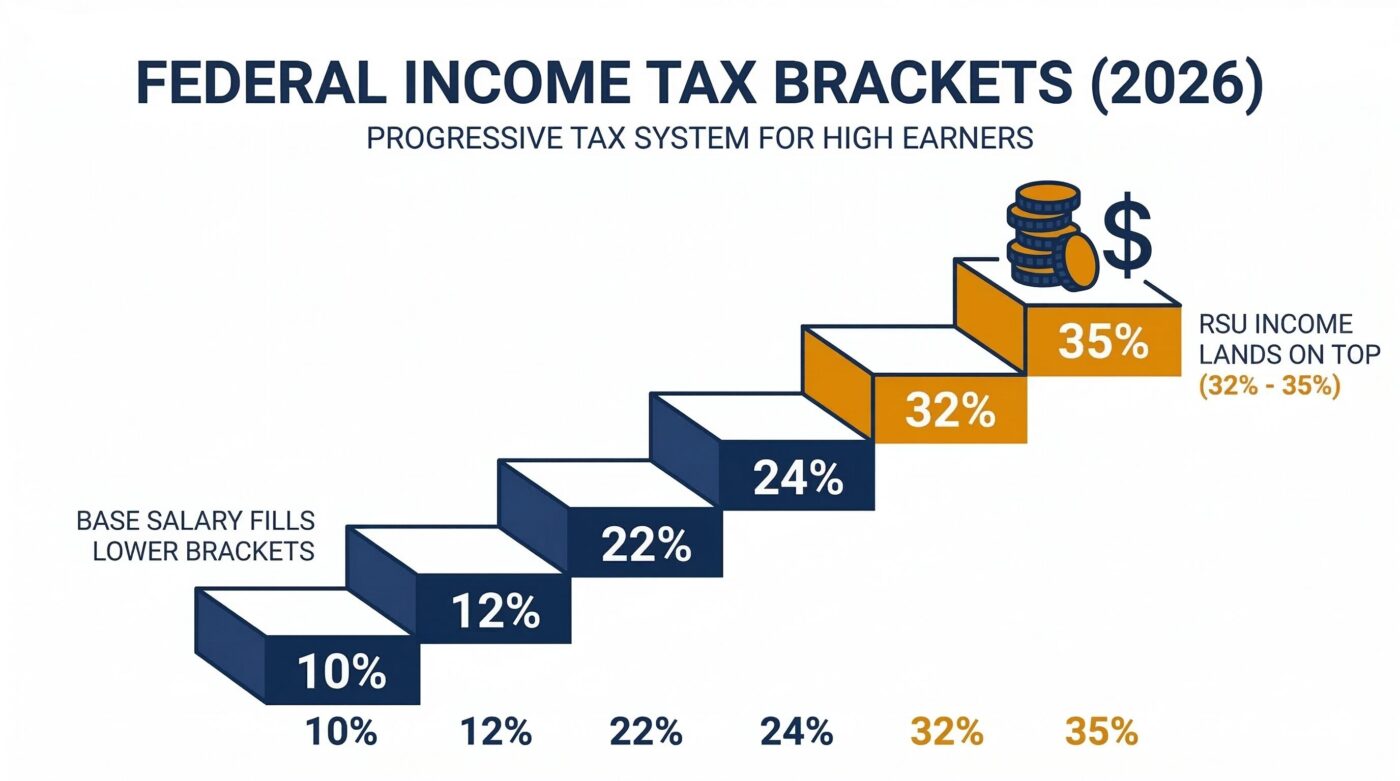
Quick note on how marginal rates work:You don't pay 35% on every dollar you earn. The progressive system taxes each slice of income at its own rate. Your base salary fills up the lower brackets first -- 10%, 12%, 22%, 24%, 32% -- in order. RSU income lands on top of your salary. In the single filer example, most of the RSU income sits in the 32% bracket, with only a small slice crossing into 35%. That's why the gap from 22% withholding is real, even if it's not always a full 13 percentage points.
Example 2: Married Couple, Two Vest Events
A couple in Bellevue. Combined W-2 income of $380,000, plus two RSU vest events totaling $200,000. Total household income: $580,000. After the 2026 standard deduction of $32,200 for married filing jointly, taxable income is roughly $547,800. The W-2 income ($347,800 after the deduction) sits in the 24% bracket. The $200,000 in RSU income lands on top in three layers: about $55,750 in the 24% bracket, $108,900 in the 32% bracket, and $35,350 crossing into the 35% bracket. The blended rate on the RSU income works out to roughly 30%.
| Amount | |
|---|---|
| Total RSU vests (two events) | $200,000 |
| Withheld by employer (22% on both) | $44,000 |
| Federal tax actually owed on RSU income (~30% blended) | ~$60,600 |
| Gap owed at filing | ~$16,600 |
Two vest events. Two separate withholding shortfalls. They compound.
Important: these examples don’t get into FICA taxes (Social Security and Medicare) or the 3.8% Net Investment Income Tax, which can add more at higher income levels. The point here is just to show the federal income tax gap in plain terms. Your actual number depends on your full picture.
How Do You Know If This Applies to You?
Here’s a quick self-check. If any of these apply, you probably have a withholding gap.
- Your total household income pushes you into the 32%, 35%, or 37% federal bracket. For 2026, the 32% bracket starts at $201,775 for single filers and $403,550 for married filing jointly. The 35% bracket starts at $256,225 single and $512,450 jointly. (Source: IRS Revenue Procedure 2025-32.)
- You had RSUs vest AND received a bonus in the same year. Both got withheld at 22%. Two shortfalls, same problem.
- Your company uses the default “sell to cover” at 22%. Most do. That’s the mechanism that creates this gap automatically.
- Pull up your W-2. Compare Box 1 (total wages) to Box 2 (federal tax withheld). If the effective withholding rate looks noticeably lower than your expected bracket, you have a gap.
Run your own numbers below. Plug in your salary and your estimated vest for the year to see which brackets your income falls into and what the gap looks like for your situation.
2026 estimated tax breakdown
Bracket breakdown — where your income lands
| Bracket | Rate | Income in bracket | Tax |
|---|
This calculator uses 2026 IRS tax brackets and standard deductions (single: $16,100 / married filing jointly: $32,200) per IRS Revenue Procedure 2025-32. Results are illustrative estimates only and do not account for FICA taxes, the 3.8% Net Investment Income Tax, itemized deductions, tax credits, or other income. This is not tax advice. Consult a qualified tax or financial professional for your specific situation. Jason Preti is a CFP® professional and owner of Unleashed Financial LLC, a registered investment adviser.
Your number is a starting point, not a verdict. We can help you close it.
The Washington State Angle: Good News at Vest, Something to Watch When You Sell
Most articles on RSU withholding stop at the federal level. Here’s what’s specific to Washington state, and it’s actually a two-part story.
The Good News: No State Income Tax at Vest
When RSUs vest, the income is taxed as ordinary income at the federal level. In most states, you’d also owe state income tax on top of that. California hits RSU income at up to 13.3%. New York at up to 10.9%. New Jersey at up to 10.75%.
Washington has no state income tax. When your shares vest, you owe nothing to Olympia on that event. That’s a real advantage, and it’s worth acknowledging.
On a $100,000 vest, a California employee could owe up to $13,300 to the state on top of federal. A Washington employee owes zero. Over a career of vesting events, that’s a meaningful difference.
The Catch: Washington’s Capital Gains Tax Applies When You Sell
Here’s where it gets more complicated. Once your shares vest, any future appreciation is subject to capital gains tax when you eventually sell — both at the federal level and, since 2022, at the Washington state level.
The WA capital gains tax structure for 2025 returns (due April 15, 2026):
| Your Net Long-Term Capital Gains | Washington Rate |
|---|---|
| Below $278,000 (standard deduction) | 0% — no tax |
| $278,001 to $1,278,000 | 7% on the taxable portion |
| Above $1,278,000 | 9.9% on gains over $1 million |
Important: The WA 2026 standard deduction has not been officially released yet.The $278,000 figure above is the confirmed 2025 amount. The 2026 deduction will be adjusted for inflation and is typically released by the WA Department of Revenue later in the year. Verify the current figure at dor.wa.gov before making any decisions.
This tax only applies to long-term capital gains — shares you’ve held for more than 12 months after vesting. If you sell immediately at vest (same day), your cost basis equals the vest price and there’s no gain to tax. No WA capital gains exposure.
Where this bites people: you’ve been vesting at Microsoft or Amazon for several years, holding your shares, watching them appreciate. You decide to diversify. Suddenly you’re sitting on a large taxable gain that pushes well above the $278,000 deduction. At 7% on those gains, the WA tax bill can be significant on top of whatever you owe federally.
Watch This Space: A Proposed WA Income Tax Is Moving Fast
As of this writing (March 2026), Washington’s legislature has passed SB 6346 — a 9.9% tax on household income above $1 million. The bill is awaiting final Senate concurrence before heading to Governor Ferguson, who has pledged to sign it. If enacted as currently written, it takes effect January 1, 2028.
If you earn above $1 million in household income, RSU vesting income after 2028 could potentially be subject to this tax. This is not settled law yet, legal challenges are virtually certain, but if you’re in that range, this is worth tracking closely with your tax advisor now, not in 2028.
For everyone below that threshold, the WA capital gains tax is the relevant question — not this proposed income tax.
Four Ways to Close the Federal Withholding Gap
The gap is predictable. Predictable problems have solutions. Here are four, in order from simplest to most involved. Managing the withholding gap is part of a broader capital gains strategy — here’s how to minimize capital gains tax with proactive planning.

1. Make Quarterly Estimated Tax Payments
If you know a vest is coming, you can pay the IRS directly rather than waiting until April. This is the most precise fix.
You do this using IRS Form 1040-ES. The due dates for 2026 income are April 15, June 16, September 15, and January 15, 2027.
The key rule to know is the “safe harbor” rule: if you pay at least 100% of last year’s total tax bill through withholding and/or estimated payments during the year, you avoid underpayment penalties — even if you still owe something at filing. If your prior-year income exceeded $150,000, the threshold bumps to 110% of last year’s bill.
Think of it like keeping a running tab with the IRS instead of letting it pile up all year and getting the invoice in April.
2. Ask HR to Bump Up Your Withholding
Many employers let you submit an updated W-4 requesting additional flat-dollar withholding per regular paycheck. This spreads the catch-up across your paychecks throughout the year instead of requiring a lump-sum payment.
It won’t solve the problem precisely. You need to calculate the right additional amount, but it’s the lowest-friction option for people who don’t want to think about quarterly deadlines. Ten minutes with HR or your payroll portal is worth checking.
3. Set the Cash Aside the Day You Vest
If your company’s default is sell-to-cover at 22%, a portion of your shares are already being sold to cover the withholding. The problem is most people take what’s left and spend or invest it without reserving for the remaining gap.
Simple fix: the day shares vest and you receive cash, move the estimated gap amount into a separate high-yield savings account. Label it “IRS money” and don’t touch it.
Rough math: if your marginal rate is 32%, the 22% withholding left a 10-point gap. At 35%, the gap is 13 points. On a $100,000 vest at 32%, that’s roughly $10,000 to set aside. At 35%, closer to $13,000. The number scales with both the vest size and your bracket.
4. Run Through It With a Financial Planner Before the Vest, Not After
A CFP® professional who works with equity compensation can look at your full picture: base salary, bonus schedule, RSU vest dates, ESPP activity, spouse income, prior-year tax liability, and any retirement contributions that could reduce taxable income.
The output is an actual number: how much to withhold, whether estimated payments make more sense, and whether tax-loss harvesting or retirement account contributions can offset some of the RSU income. Pre-tax 401(k) contributions, in particular, reduce your taxable income dollar for dollar and can meaningfully lower which bracket your RSU income lands in.
The right time to do this is not April 14. It’s when you get your vest schedule for the year. A mid-year check-in matters too, especially if your income situation has changed, a promotion, a spouse changing jobs, or an unexpected large vest.
Don’t Let Washington’s No-Income-Tax Status Give You a False Sense of Security
No state income tax is genuinely valuable. At every vest event, you’re ahead of your peers in California, New York, and Massachusetts. That’s real money, year after year.
But Washington’s tax landscape is changing. The capital gains tax is here to stay. Voters rejected a repeal effort in 2024 by more than 63%. The rate structure is now tiered. And a significant new income tax proposal is working its way through Olympia right now.
The federal withholding gap and the WA capital gains question are separate problems. Both are equity compensation problems. And both are solvable with some planning before they show up as surprises.
If you’ve been accumulating shares and haven’t mapped out what your WA capital gains exposure looks like on a large sale, that conversation is worth having before you decide to diversify a concentrated position.
The Bottom Line
This isn’t a punishment for doing well. It’s a gap that exists because the tax system wasn’t built for people who have equity compensation as a major piece of their income. The 22% shortcut made sense for someone else. Not for you.
The good news is that it’s predictable. And predictable problems have solutions: estimated payments, updated withholding, a cash reserve, or a mid-year planning conversation. Any one of those beats getting blindsided in April.
If you’re not sure where you stand, reach out. We can look at your vest schedule, run through your full income picture, and figure out what you actually need to set aside — before TurboTax tells you in April.
Want to bookmark the calculator on its own? It has its own page here: RSU Calculator