

When it comes to investing, boring is beautiful. Too often, people get caught up chasing hot stocks or trying to time the market. But the unsexy truth is that successful investing over the long run is about managing risk through diversification and sticking to a disciplined strategy. It’s not flashy, but it works.
Managing Risk is Job #1 at Any Age
Many assume risk management is only important once you’re older and nearing retirement. However, protecting your money from big losses must be prioritized at every stage.
In your 20s and 30s, you have decades of future earnings ahead to recover from setbacks. But why take excessive risk in the first place? Limiting downside through asset allocation and diversification means you don’t gamble unnecessarily.
Managing risk becomes even more critical as your net worth grows in your 40s and 50s. Big losses can derail retirement when you lack time to make up ground. Protecting what you’ve accumulated takes priority over aggressive stock-picking.
Avoiding Uncompensated Risks
Not all investment risks are equal. There are compensated risks that provide higher expected returns over long periods. And uncompensated risks that expose you to potential losses without superior gains.
Holding too much in a single stock is a prime example of uncompensated risk. While some may beat the market in the short term, individual stocks generally fail to outperform diversified funds over the long term. The excess, unsystematic concentration risk is not compensated by higher expected returns.
For tech professionals with RSUs and ESPP, this uncompensated concentration risk builds quietly over time — here’s how to calculate your true exposure.
Systematic vs. Unsystematic Risk
Systematic risk refers to broad risks that affect the overall market, like recessions or interest rate changes. Unsystematic risk is the company-specific risk impacting a single stock’s returns. By holding many stocks, unsystematic risks are diversified away while systematic risks remain.
A Better Way
This doesn’t mean avoiding all risk – equity ownership carries significant systematic risk. But it’s a compensated risk – over long periods, stocks have paid off for riding out volatility.
The key is taking smart, compensated risks by investing in diversified funds. This lets you capture equity upside while minimizing uncompensated single-stock risks. Your risk is pooled across many securities rather than concentrated bets.
Diversification reduces risk without sacrificing expected returns. It’s investing’s “free lunch”—by spreading across assets and styles, you avoid taking excessive risks the market can’t reasonably compensate for.
The Power of Diversification
One of the most powerful tools for managing risk and improving your portfolio’s overall risk/return profile is diversification across asset classes. By holding different investment types that do not move in perfect lockstep, you can actually lower volatility without sacrificing expected returns.
For example, let’s compare three hypothetical portfolios held for 30 years:
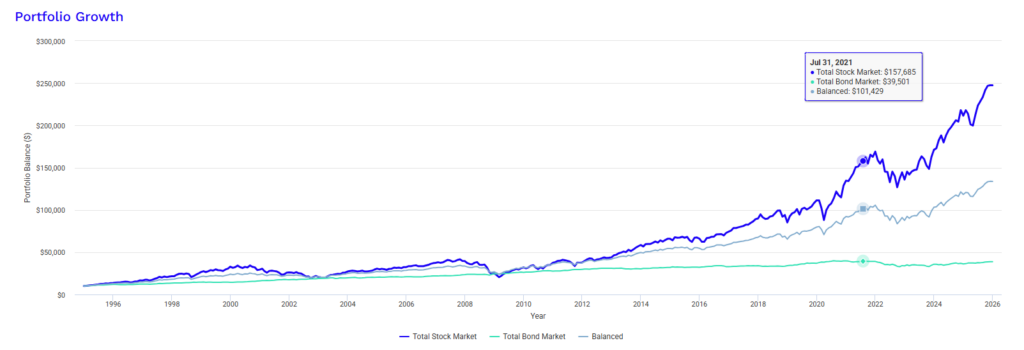
Performance Summary (Jan 1995 – Dec 2025)
| Metric | 100% Equities | 100% Bonds | Balanced |
|---|---|---|---|
| Start Balance | $10,000 | $10,000 | $10,000 |
| End Balance | $247,414 | $38,693 | $133,667 |
| Annualized Return | 10.90% | 4.46% | 9.53% |
| Standard Deviation | 15.49% | 4.13% | 9.53% |
Portfolio 1: 100% Equities
An aggressive all-stock portfolio may seem attractive, given equities’ higher expected returns. But a 100% equity position also carries extreme volatility, including this portfolio’s worst year of -37%.
Portfolio 2: 100% Bonds
While government bonds lack stocks’ return potential, a 100% fixed-income portfolio provides stability and avoids major losses, though it still exposes you to inflation risk over time.
Portfolio 3: Balanced
This balanced portfolio captures a significant portion of the stock market’s higher expected returns while also enjoying the diversification benefits of bonds to lower volatility and downside risk.
Over 30 years, the all-equity portfolio ended up with higher overall returns but at the cost of extreme volatility. The 60/40 portfolio achieved excellent returns with significantly reduced risk and steadier performance year-to-year.
The takeaway is that combining assets like stocks and high-quality bonds can yield a “free lunch” – you can actually reduce your portfolio’s overall risk while still keeping expected returns high through the compounding of different return streams over time.
Build Wealth Slowly and Steadily
The greatest wealth is created not through home run bets but by steady, consistent, diversified investing over decades. The boring ~8% annual return may seem low, but compounding over 40-50 years can turn modest investments into a considerable nest egg.
For a deeper look at why active funds underperform on an after-tax basis — which matters especially when selling RSUs — here’s the data on the after-tax effect of active versus index investing.
Pushing for higher returns often means taking excessive risks that can decimate portfolios in downturns. While boring, low-cost, diversified funds are the safest path to financial independence.
So embrace the power of boring, disciplined, diversified investing. It allows you to capture market returns while managing risks prudently. Avoiding uncompensated bets is what allows investors to cross the finish line successfully.